This is a page where I’m doing some public musing around the idea of endowments-for-people. Ideas here are in-progress and some things are unresolved.
What is the big idea?
We endow people, rather than projects or programs.
We pool capital and invest it, then use the returns from the investments to provide financial stability to individuals, first for the short term, then forever.
Over time, we create an expanding community of financially secure people, free to contribute, create, and support others.
Where does this idea come from?
My spouse and I have been lucky, and worked hard, to achieve financial stability. We had help from family with college, first cars, rent, and innumerable other things as we were starting out. We’ve worked hard and lived frugally, and created financial breathing room for ourselves.
As we started to achieve our financial goals, new versions of this cycle played out - I worked more for a season while Greg finished school, now Greg has supported me taking a step back from my engineering job to explore my leadings around work and contributing to our community.
We’ve started to ask - after providing for our family, what’s next? What are we building? What kind of legacy do we want to leave?
We’re starting to play with the idea of how to create a system that allows us to share in the spirit family gave to us, and the way we have given within our marriage - with generosity rather than charity at the core.
The Long Term Vision
Right now, our long term idea is to create a permanent fund of some kind that provides money for people for their whole lives purely as returns from investments. How much money is an open question - a small amount to make living expenses more manageable? A living wage? Something in-between?
We do feel pretty sure that in general the money should be given unconditionally, with selection by nomination and lottery.
The feeling here is how our family gave to us - with trust that we would use the leg up to work hard and contribute, without some elaborate system of surveillance or control.
The vision is to unlock more individuals and families as we feel we’ve been unlocked - creating more freedom, more opportunities for people to follow their leadings and be creative in the ways they contribute.
We hope and believe that people who receive an endowment will keep working, earning, and contributing to seed future endowments and spread the Common Inheritance.
These are some pretty lofty ideas, and ultimately this is a vision that would take time to unfold. So think generational scale, with the goal being to start trying things out in the next decade so we could have the infrastructure to leave our estate to this program.
We’d like to set this up in a way that works for us locally, and share what we learn in a way that allows other communities to implement their own versions too.
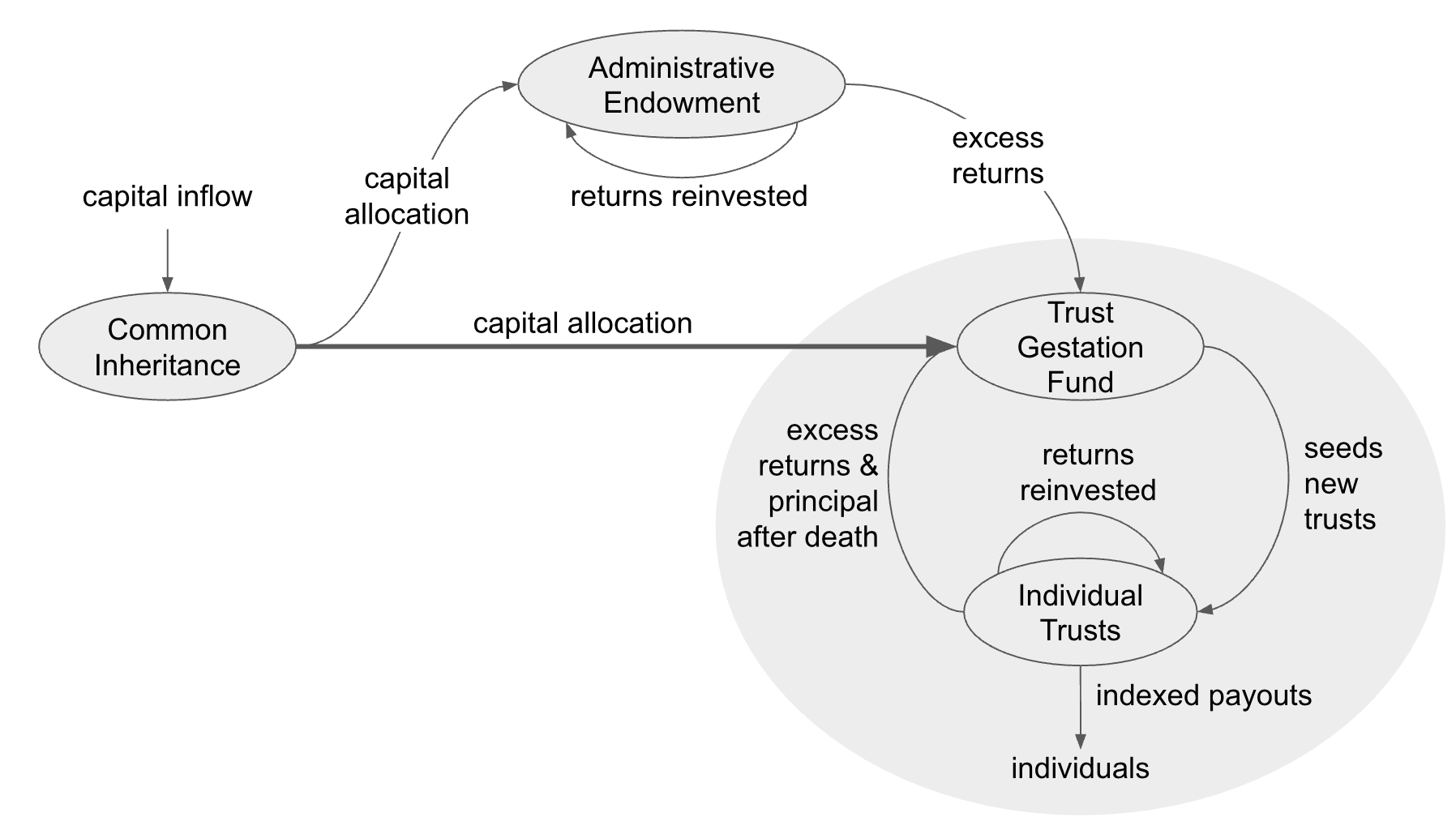
Starting Out
There’s a lot of questions to sort out about how this would work from a legal and governance perspective. We want to figure out something that’s really lightweight and resists takeover and exploitation.
One sort of vision here is a set of governing documents like a trust or something, and then basically a separate fund that exists to pay a lawyer to annually review and update those documents in accordance with state and federal law. We want to avoid some elaborate board of governance.
In the short term however, I think having some decision makers to run a pilot and evaluate if things are working is necessary. I think at this point that group would probably be made up of the contributors to the pilot fund and the participant, but I’m not sure if this is the best approach and if perhaps there is a better way to select a few decision makers.
My current idea is that we try to pilot a single year-long endowment for somewhere between $500-$1,000 a month, with the idea that this would cover most or all of someone’s rent here in Ann Arbor. This would require a fund in the neighborhood of $150,000-$300,000.
I think the simplest way to start would be to run the initial pilot through the Ann Arbor Friends Meeting, if the Meeting agrees. This would allow us to use the non-profit status of the Meeting to make donations tax-deductible and prevent us from having to do a lot of admin / overhead at first.
I think we would need to choose a charity to donate to at the end of the pilot if we decide not to continue the program. I’m thinking something like Give Directly which is in line with the same ideas.
The “starting out” phase would, I think, entail fleshing out what this would need to look like administratively, figuring out if the Meeting could host this project, raising funds, and running a one-year pilot.
Goals for us would probably include learning about governance, the legal frameworks, and the social realities of the system at a small scale.
Hitting our Stride
I think if we manage to get all the way through implementing a one-year pilot, we’ll be in a great position to start looking at what it would take to make Common Inheritance it’s own entity. We’d have a proof of concept and some lessons learned that could either inform an updated 1-year program, or if we felt ready we could transition into creating longer-term endowments.
At some point, after one or a few short term cycles, I’d hope we’d start creating long-term or permanent endowments at higher dollar values.
Selection for the Common Inheritance
I’m not trying to address every technical / functional aspect of how this would work at this point. These are the basic ideas that we think are important.
The basic idea would be that people who contribute to the Inheritance fund can nominate potential recipients. A recipient would be chosen via lottery from among the nominees.
We think the goal should be to have a simple, fair, non-discriminatory system, and to encourage contributing as a way to liberate others.
This selection system does have tradeoffs - I’m not sure from an economic perspective it would be the most efficient, and certainly doesn’t guarantee that those most in need receive aid first. It is much more keyed to network effects and trying to concentrate and grow the Inheritance outward from a tight network rather than having it be diffuse across a wide group.
What the Common Inheritance Isn’t
- Charity
- a loan
- a jobs program
- a meritocracy
- a guarantee of good or equal outcomes
Open questions
- What’s the legal structure for something like this?
- What will tax implications be for founders and recipients?
- How will this be governed? As a big guy or a series of distributed guys?
- How will payouts be calculated, like what formulas will be used?
- What will the investment philosophy be?
- How will the endowment amount be determined, e.g. if living wage, how is that indexed?
- How will we grow without losing trust? How will we resist takeover or exploitation like those lead cases?
https://jmc877.github.io/Corporate-Finance/WasPost_Settlement_Lead_15.pdf
- Do we feel OK about the endowment model for everyone? Are there people with higher support needs, who we could envision being nominated in later chapters of this legacy, for whom direct cash is not appropriate? How will that be handled?
- How do we envision this spreading? Eventually one big thing that covers the whole country? Should it be a series of small things like a trust that get replicated but then are independent? Can we make a framework where other people can start a Common Inheritance pool in their community? Want to keep network effects strong rather than dilute too greatly - so a geographic or very strong online cultural component seems important to me
Links
https://www.schwab.com/learn/story/case-establishing-dynasty-trust
https://en.wikipedia.org/wiki/Dynasty_trust
https://www.reddit.com/r/economy/comments/1pkekp4/a_huge_private_endowment_ubi_social_wealth_fund/
https://avgintel.substack.com/p/are-university-endowments-the-path